
Why SEO Is Important for Website Ranking
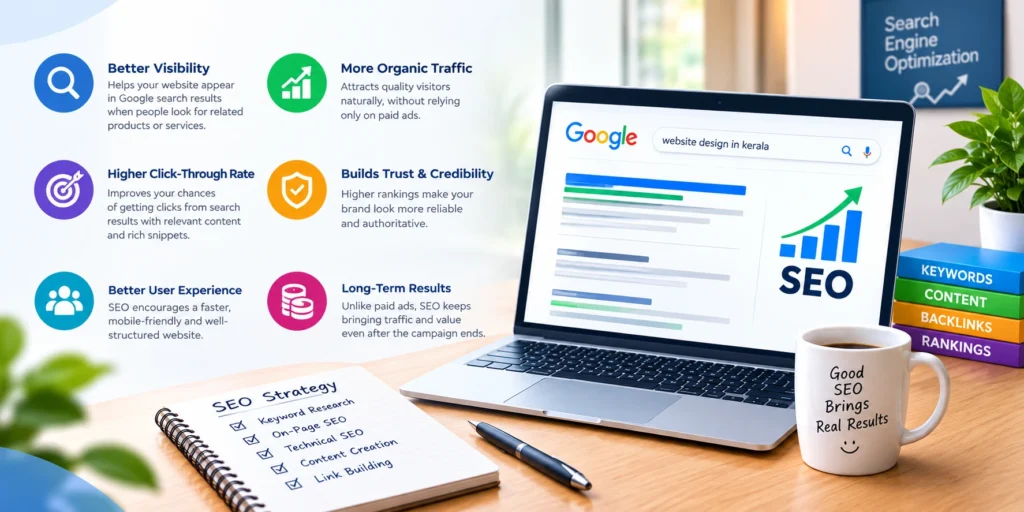
When people search for products, services, or information online, they are more likely to visit websites that appear prominently in search results. SEO helps improve website ranking by optimizing important areas of a website, including content, keywords, technical structure, page speed, mobile usability, and links.
A well-planned SEO strategy can help a website reach people who are already searching for the products or services a business provides.
How SEO Improves Search Engine Visibility
One of the main benefits of SEO for websites is improved search engine visibility. By using relevant keywords and creating useful content, a website can increase its opportunity to appear in search results for topics related to its products or services.
For example, a website targeting the keyword “Web Designer in Kerala” can create relevant content around website design, web development, search engine optimization, and digital marketing.
How SEO Increases Organic Website Traffic
Organic traffic refers to visitors who reach a website through unpaid search engine results. Unlike paid advertising, SEO focuses on improving a website’s natural visibility in search engines.
When a website ranks for relevant search terms, potential customers can discover the website without the business paying for every click. This can help attract a more targeted audience that is already interested in a particular product, service, or topic.
Several factors can contribute to better website ranking and SEO performance. These include relevant keyword research, useful and original content, proper heading structure, optimized title tags and meta descriptions, image optimization, descriptive ALT text, website speed, mobile-friendly design, internal linking, quality backlinks, technical SEO, and a good user experience.
SEO is a long-term digital marketing strategy. Search rankings can take time to improve, and results can vary depending on competition, website quality, search intent, industry, and the SEO work being performed.
Instead of focusing only on short-term traffic, businesses can continuously improve their websites, publish useful content, target relevant search terms, and build a stronger presence in organic search results.
Key SEO Practices for Better Search Rankings
A successful SEO strategy combines several areas of optimization instead of focusing on only one ranking factor.
Keyword Research: Identify relevant search terms that match your audience, services, and business goals.
On-Page SEO: Optimize page titles, headings, content, URLs, images, and internal links.
Technical SEO: Improve website speed, mobile usability, crawlability, indexing, and overall technical structure.
Content SEO: Create useful, original, and informative content that answers questions people are searching for.
Off-Page SEO: Build website credibility through relevant and trustworthy external links and online references.
Local SEO: Businesses serving specific locations can optimize their website and online presence for relevant local searches.
SEO and User Experience
SEO and user experience work closely together. Visitors should be able to find information easily, navigate the website comfortably, and access pages quickly on desktop and mobile devices.
A website with useful content, clear navigation, fast loading pages, and a simple structure can provide a better experience for visitors while also making it easier for search engines to understand the website.
Why Keywords Matter in SEO
SEO keywords connect what people search for with the content published on your website. Using relevant keywords naturally in page titles, headings, paragraphs, URLs, and image ALT text can help search engines understand the subject of a webpage.
However, keywords should always be used naturally. Repeating the same keyword excessively can make content difficult to read and may create a poor experience for visitors.
SEO Is More Than Just Website Ranking
Website ranking is an important part of SEO, but SEO is not only about reaching a higher position in search results. Its broader purpose is to connect the right audience with useful information, products, or services.
A strong SEO strategy can help a website improve its visibility, attract targeted organic traffic, strengthen its online presence, improve user experience, and create opportunities for enquiries and conversions.
Conclusion: The Importance of SEO for Website Success
The importance of SEO in website ranking continues to grow as more businesses compete for visibility online. A website with a strong SEO foundation can make it easier for search engines to understand its content and for potential customers to discover its products or services.
From keyword research and quality content to technical SEO, mobile optimization, internal linking, and user experience, different aspects of SEO work together to create a stronger online presence.
If you want your website to grow organically and reach more potential customers, SEO should be an important part of your overall digital marketing strategy.